What Is an AI Marketing Agent? A Plain-English Guide
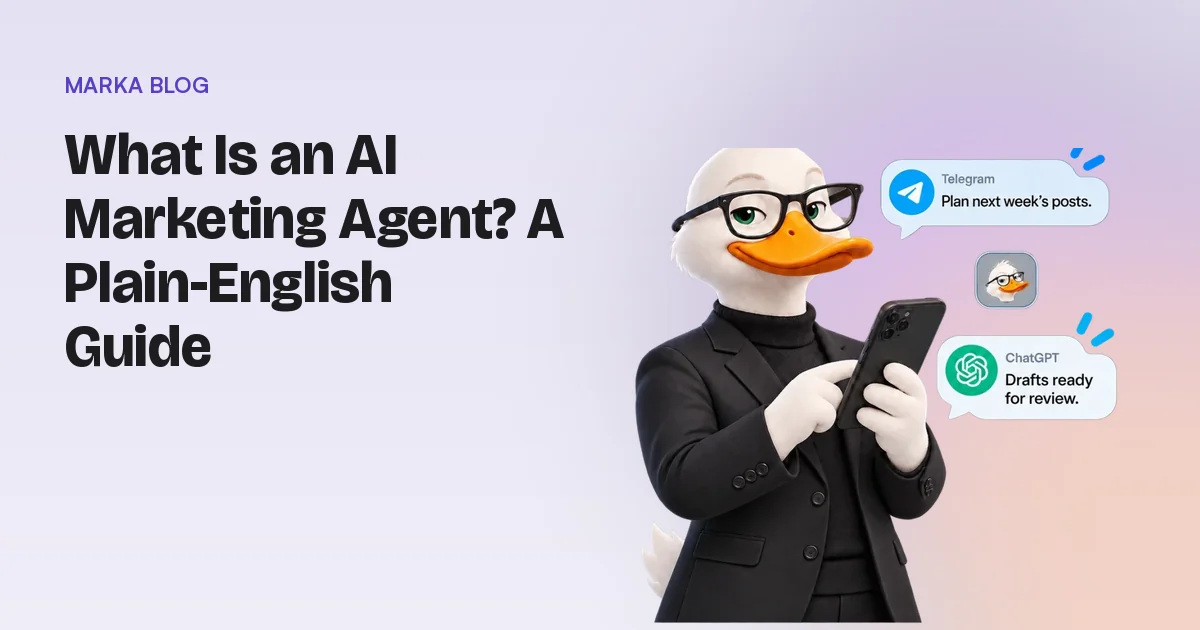
An AI marketing agent is software that works toward a marketing goal for you. It plans the steps, uses tools to carry them out and adjusts based on results, while you approve the decisions that matter. Where a chatbot answers when asked, an agent keeps working between your messages, for example drafting next week's posts and sending them to you for a yes.
The term is new and loosely used. A note on our interest: Marka, which publishes this guide, makes an AI marketing agent that works through WhatsApp and shows the credit price of each item before it is made. We have tried to keep the criteria below useful whichever tool you choose.
Key Takeaways
- Google Cloud defines AI agents as software that pursues goals and completes tasks for users, showing reasoning, planning and memory.
- The difference from an assistant is initiative: an assistant waits for prompts, an agent works toward a goal and reports back.
- For small businesses, the most useful agents handle repetitive marketing work: planning, drafting posts and scheduling.
- Gartner warns of "agent washing": many products are relabelled chatbots or automation.
- Look for clear control: how you approve work, and how you will know what it costs.
In this guide:
- What does "AI marketing agent" mean?
- How is an agent different from an AI assistant or automation?
- What can an AI marketing agent do for a small business?
- What can't it do, and what are the risks?
- What a week with an agent looks like
- How to evaluate an AI marketing agent
- Is an AI marketing agent right for your business?
- Frequently Asked Questions
- In short
What does "AI marketing agent" mean?
Google Cloud describes AI agents as software systems that use AI to pursue goals and complete tasks on behalf of users, showing reasoning, planning and memory, with some autonomy to make decisions, learn and adapt (Google Cloud). An AI marketing agent applies that to marketing work: understanding your business, deciding what content or campaigns to make, producing them and handling the follow-up.
In practice, a marketing agent combines four parts:
- Context: what it knows about your business, such as products, audience, voice and past posts.
- A goal: for example, three on-brand posts a week on Instagram.
- Tools: writing, image and video generation, a calendar and publishing connections.
- A loop: it plans, acts, shows you the result and adjusts.
How is an agent different from an AI assistant or automation?
| Aspect | Marketing automation | AI assistant | AI marketing agent |
|---|---|---|---|
| How it starts | A rule or trigger you set | Your prompt | A goal you set |
| What it does | The same steps every time | Answers or drafts on request | Plans and runs multi-step work |
| Who decides | You, in advance | You, after each answer | It proposes; you approve key steps |
| Example | "Send this email when someone signs up" | "Write a caption for this photo" | "Plan and draft next week's posts, then send them for approval" |
Google Cloud draws the same line: an AI assistant responds to requests and can recommend actions, but the user makes the decisions, while an agent can perform complex, multi-step actions more independently (Google Cloud).
What can an AI marketing agent do for a small business?
The most useful jobs are the repetitive ones that take an owner's evenings:
- Learn the brand: read your website and build a profile of your products, voice, colours and audience.
- Plan content: suggest a weekly or monthly calendar based on your offers and seasons.
- Make the content: write captions, design images and carousels, and cut short videos.
- Ask for approval: send drafts to you, take your changes and revise.
- Schedule and publish: post approved content to connected accounts at set times.
- Report back: tell you what was posted and how it performed.
Some agents run inside a web app; others work through chat apps you already use, such as WhatsApp. Our buyer's guide to AI social media post generators covers how to compare them.
What can't it do, and what are the risks?
Agents are still early, and the label is used generously. Gartner predicted in June 2025 that over 40% of agentic AI projects will be cancelled by the end of 2027 because of rising costs, unclear business value or weak risk controls. It also warned of "agent washing", the relabelling of assistants, chatbots and automation as agents, and estimated that only about 130 of the thousands of vendors claiming agentic AI are real (Gartner, June 2025).
For a small business, the practical risks are smaller but real:
- Wrong facts: an agent can misread your site or invent details. Every post needs a check.
- Generic output: without a good brand profile, an agent produces posts that could belong to anyone.
- Runaway activity: an agent that publishes without approval can post something off-brand or badly timed.
- Unclear costs: usage-based pricing can surprise you if you cannot see the cost before work starts.
Adoption is also uneven. The U.S. Census Bureau found that fewer than 20% of firms with four or fewer employees used AI in spring 2026, and its survey now measures AI use in specific functions such as marketing (U.S. Census Bureau, May 2026). Most of the smallest firms do not use AI yet, according to that survey.
What a week with an agent looks like
A fictional example, for a small florist. On Monday the agent suggests three posts for the week: Mother's Day pre-orders, a care tip and a behind-the-scenes clip. The owner rejects the care tip, asks for the clip to use this morning's delivery, and approves the pre-order post. On Wednesday the agent sends the new clip, and the owner approves it from their phone. On Friday it reports which post got the most saves and suggests repeating that format next week.
The agent did the planning, making and scheduling. The owner made four quick decisions, and nothing went out without a yes.
How to evaluate an AI marketing agent
Ask these questions before you pay:
- What does it learn from? Your website, your files, or only a few form fields?
- Can you edit its brand profile? You should be able to correct voice, facts and visuals.
- What can it make? Single images only, or carousels and video too?
- How does approval work? Can you see and change everything before it goes out?
- Where do you work with it? In a web dashboard, a mobile app or a chat app?
- How is it priced? Fixed plans, credits or per-item costs, and how will you know what a month costs?
- What does it publish to? Which platforms, and what happens if a connection fails?
Two of our comparisons apply these questions to real products: Marka vs Holo and Pomelli alternatives.
Is an AI marketing agent right for your business?
It is a good fit if you know what you want to post but lack the time to make it, if you are comfortable approving drafts quickly and if your marketing is mostly social content. It is a poor fit if you need a full strategy rethink, heavy paid advertising management or content that depends on your personal presence on camera every day.
For where an agent fits alongside other tools and a weekly routine, read our guide to AI social media marketing for small business.
Frequently Asked Questions
What is an example of an AI marketing agent?
Google added an agent to its Pomelli experiment in May 2026 that builds a brand profile from your files or a chat (Google). Holo describes reading your website, planning content and asking you to approve it on your phone before autopilot (Holo). Marka, our product, does similar work through WhatsApp. Scope and pricing differ a lot between them.
Are AI marketing agents fully autonomous?
They can be, but for a small business they should not be. The safest setup lets the agent plan and draft on its own while you approve anything that goes public.
Will an AI marketing agent replace a marketer?
It replaces much of the production work: drafting, resizing, scheduling. It does not replace knowing your customers, deciding what the business needs or judging what is worth saying.
How much does an AI marketing agent cost?
In the tools we compared for this blog, prices run from free to under $200 a month. Compare what is included, such as the number of posts, video, approvals and publishing, rather than the monthly price alone.
In short
An AI marketing agent is a tool that takes a goal, plans and does the work, and checks in with you. Judge it by what it learns from, how you approve its work and whether you can see the cost before it acts.
About this guide: written by Shalev Amin, co-founder of Marka, with AI assistance, and checked against the linked sources. Our editorial rules: every fact links to the source we checked it against, checks are dated, pages are updated when products, prices or data change, and we say so whenever we compare our own product, Marka, with other tools. Last checked on 1 November 2026. Spotted an error? Contact us and we will correct it. More about Marka.